
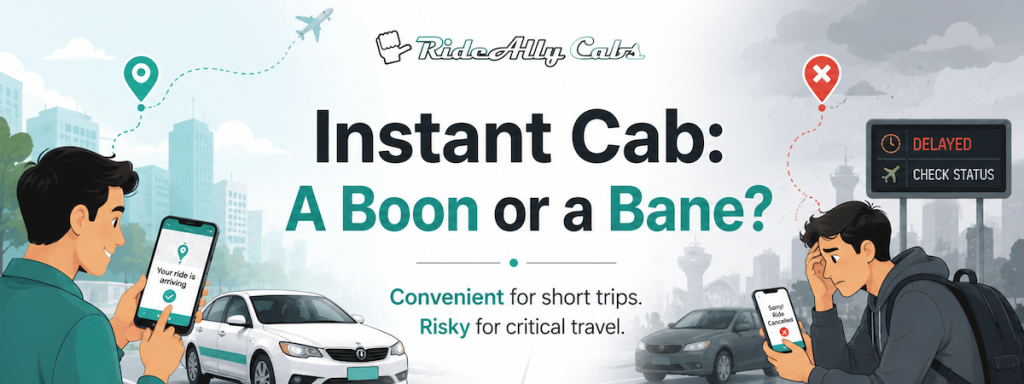
Instant Cabs – A Boon or Bane?
Travel is one of the most basic needs of human life. Just like food, clothing, and shelter, popularly known as “Roti, Kapda aur Makaan”. Travel is part of our everyday existence.
From birth till old age, we keep travelling for different reasons: school, office, visiting friends and relatives, attending events, tourism, pilgrimage, railway stations, airports, bus stands, hospitals, family functions, business meetings, and much more.
Over the years, the way people travel has changed significantly. Earlier, people planned important travel in advance. Today, with smartphones and app-based cab platforms, many people have developed the habit of booking cabs instantly, even for critical travel.
But this raises an important question:
Is instant cab booking really a boon, or has it slowly become a bane for critical travel?
Understanding Different Types of Travel
Broadly, travel can be classified into three categories, Area wise, distance wise and timing wise.
Area Wise Travel
- Intra-City Travel: It means travelling within the limits of a city or town. These trips may include going from one point to another, shopping, office commute, airport transfers, railway station transfers, city tours, or hourly rentals such as 4hr/40km or 8hr/80km packages.
- Inter-City Travel: Inter-city travel means travelling from one city or town to another. Examples include Bengaluru to Mysuru, Mumbai to Pune, Delhi to Chandigarh, Hyderabad to Tirupati, Chennai to Rameshwaram, and many more. These journeys are usually planned in advance.
Distance Wise Travel
- Short Distance Trips: Short distance trips are usually less than 10 to 15 km. Traditionally, people used auto-rickshaws, bikes, or personal vehicles for such trips.
- Long Distance Trips: Long distance trips are usually more than 15 km. For these trips, people generally prefer personal cars or booked cabs.
For long distance and important travel, reliability matters much more than instant availability.
Timing Wise Travel
- Instant Trips: Instant trips are sudden travel needs. These may come up due to emergencies, unexpected work, last-minute meetings, etc.
- Planned Trips: Planned trips are journeys that are known in advance. Airport drops, railway station transfers, outstation trips, family events, business meetings, hospital appointments, school/college travel, and rentals can usually be planned at least a few hours earlier.
In reality, except for genuine emergencies, most travel can be planned at least 3 to 4 hours in advance. This is where the debate around instant cabs becomes important.
What is the Concept of Instant Cab?
Instant cab means a cab or taxi that is expected to be available within a few minutes, whenever and wherever the passenger wants to travel.
This concept became very popular when large cab aggregators such as Ola and Uber entered the Indian market. Ola started in December 2010 and later expanded across major cities. Uber entered India in 2013. Both platforms changed urban mobility by making app-based cab booking simple and accessible.
For customers, it felt like magic.
A passenger could sit at home, open an app, choose a cab, see the estimated fare, track the driver, and travel in the comfort of a car, often at a price close to an auto-rickshaw.
No bargaining. No standing on the road. No register-based booking.
For a few years, this worked very well.
Why Instant Cabs Worked in the Early Days
Ola, Uber, and other app-based cab platforms invested heavily to change customer behaviour.
Customers were offered affordable fares. Drivers were offered strong incentives. Even if a customer paid only ₹100 for a short trip, the driver could still earn more because incentives made the trip worthwhile.
Many drivers who were earlier working with local cab agencies moved to large aggregators. Some people who did not even own vehicles bought commercial cars, sometimes through loans, and attached them with these platforms. For many drivers, becoming a car owner felt like a dream come true.
Instant cabs became a habit. Slowly, customers started believing that they could get a cab anytime, anywhere.
People started booking even critical rides at the last moment: airport drops, hospital visits, railway station transfers, late-night pickups, and family travel.
But the question is: Was it naturally sustainable, or was it supported by heavy incentives?
But dreams built on incentives can become difficult when incentives reduce.
As the model matured, incentives started reducing. Driver earnings came under pressure. Fuel prices, maintenance costs, traffic, waiting time, platform commissions, and loan EMIs made the economics difficult.
Once this happened, many drivers became selective.
- They started checking the destination.
- They started preferring cash payments.
- They avoided short rides.
- They avoided heavy traffic routes.
- They avoided residential lanes.
- They cancelled rides after accepting.
- They ignored calls when the ride was not attractive.
- This is where the problem started for passengers.
Is Instant Cab Booking Working the Same Way Today?
Instant cab booking is still useful for many flexible, non-critical trips. But for critical travel, the reliability has reduced significantly.
Today, many passengers face problems such as:
- Drivers accepting and then cancelling rides
- Drivers calling to ask the drop location before coming
- Drivers refusing online payment and asking for cash
- No cab availability during peak hours
- Long waiting time despite multiple booking attempts
- Drivers refusing to enter residential lanes
- Driver or vehicle details changing at the last moment
- Poor response from customer support during urgent situations
- Passengers getting stranded at night, during rain, or during emergencies
The biggest issue is not whether a cab is shown on the app.
The real issue is: Will the cab actually come when you need it most?
Real Passenger Experiences with Instant Cab Booking
The following incidents are based on real passenger experiences. Names have been changed to protect privacy, but the situations reflect common challenges faced by many users of instant cab platforms.
Puja: “I No Longer Trust Instant Cabs Like Before”
Puja, a regular commuter from BTM to Hosakerehalli, Bengaluru, says she no longer depends on big instant cab platforms the way she used to.
Even on normal days, with no rain, strike, or unusual traffic, she sometimes struggles to get a cab for a long time. Her preference has now shifted to public transport, personal vehicles, or smaller cab providers where she can book in advance.
For her, the issue is simple: earlier she trusted instant availability; now she is no longer sure.
Suresh: “The Driver Asked My Drop Location and Cancelled”
Suresh once booked a cab while travelling with his family and small children. He expected the cab to arrive within 5 minutes.
The driver accepted the ride, called to ask the drop location, and then cancelled. After multiple failed attempts, Suresh had to step out with his family and search for an auto-rickshaw.
The auto driver demanded almost double the meter fare. Suresh had no option but to agree.
For him, the bigger problem was not just the extra fare. It was the helplessness of being stranded with family
Parimal: “I Missed My Flight”
Parimal is a frequent airport traveller. For a long time, he trusted instant cab platforms for airport travel.
He had an important flight to catch. During peak hours, no driver accepted his ride for a long time. Finally, a cab was assigned, but the driver did not answer calls and the vehicle did not move.
After almost an hour of anxiety, he had to cancel his travel plan.
For airport travel, even a 20–30 minute delay can lead to missed flights, financial loss, and mental stress.
The Common Pattern Behind These Stories
These stories are different, but the pattern is the same.
- The passenger books a cab expecting quick service.
- The driver accepts but does not fully commit.
- The driver checks destination, payment mode, or pickup location.
- The ride gets cancelled or delayed.
- The passenger becomes anxious, stranded, or forced to pay extra elsewhere.
For casual travel, this may be inconvenient. For critical travel, this can be disastrous.
The Myth of “Cab Anytime, Anywhere”
The biggest belief created by instant cab platforms is:
“Open the app and a cab will come.”
This belief was powerful because it worked well in the early years. But today, many passengers are realising that instant cab booking does not guarantee cab arrival.
A cab may be visible on the app. A driver may be assigned. The estimated time may show 5 minutes. The fare may look attractive.
But none of this guarantees that the driver will actually come.
For critical travel, visibility is not enough. Booking confirmation is not enough. Driver assignment is not enough.
What matters is fulfilment.
The cab must arrive. The driver must be reachable. The ride must happen.
That is the real service.
Instant Cab: A Boon or a Bane?
Instant cabs were definitely a boon when they solved real problems of accessibility, affordability, and convenience. They helped many drivers get more earning opportunities. They changed the way India travelled within cities.
They are still useful for short, flexible, non-critical rides.
But for airport transfers, hospital visits, railway station drops, family trips, outstation travel, early morning pickups, late-night rides, and business meetings, depending on an instant cab at the last moment can be risky.
The issue is not instant cab booking itself. The issue is using instant booking for journeys where failure is not acceptable.
Why Planned Cab Booking Is More Reliable
Most important travel can be planned at least 3 to 4 hours in advance. This small planning window makes a big difference.
It gives the cab provider time to assign the right vehicle, verify driver availability, share details, coordinate pickup, monitor movement, and arrange backup if required.
Planned cab booking reduces panic. It improves accountability. It gives passengers peace of mind.
For critical travel, planning is not old-fashioned. Planning is protection.
RideAlly’s View
At RideAlly, we believe that important travel should not depend on luck.
RideAlly focuses on planned cab services for airport pickups and drops, hourly rentals, family trips, events, and outstation travel.
These are journeys where reliability matters more than instant availability.
That is why RideAlly encourages customers to book at least 3 hours in advance.
This gives the team enough time to assign, coordinate, monitor, and support the ride properly.
For critical travel, the expectation should be simple:
The cab should come. The driver should be reachable. The customer should travel peacefully.
Final Thought
Instant cab booking gave India convenience. But convenience without reliability is incomplete.
For casual travel, instant booking may still work.
But when your journey is important, do not leave it to chance.
Plan your ride. Book in advance. Travel peacefully.
Because when travel is important, cab arrival should not be a question mark.
Leave a Reply