
Carpooling Is Back. Are the Rules Ready?
Bengaluru Traffic Police is once again talking about regulated carpooling. Read The Hindu report
RideAlly welcomes the move but regulation, not another campaign, will decide whether it succeeds.
In October 2015, there was an unusual sense of optimism around Bengaluru traffic.
Bengaluru Traffic Police had decided that instead of only managing congestion, perhaps we should also reduce the number of vehicles creating that congestion.
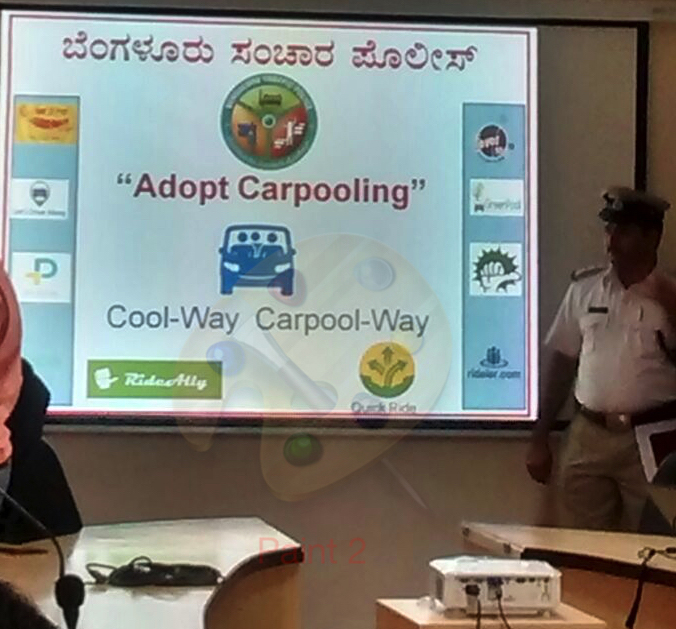
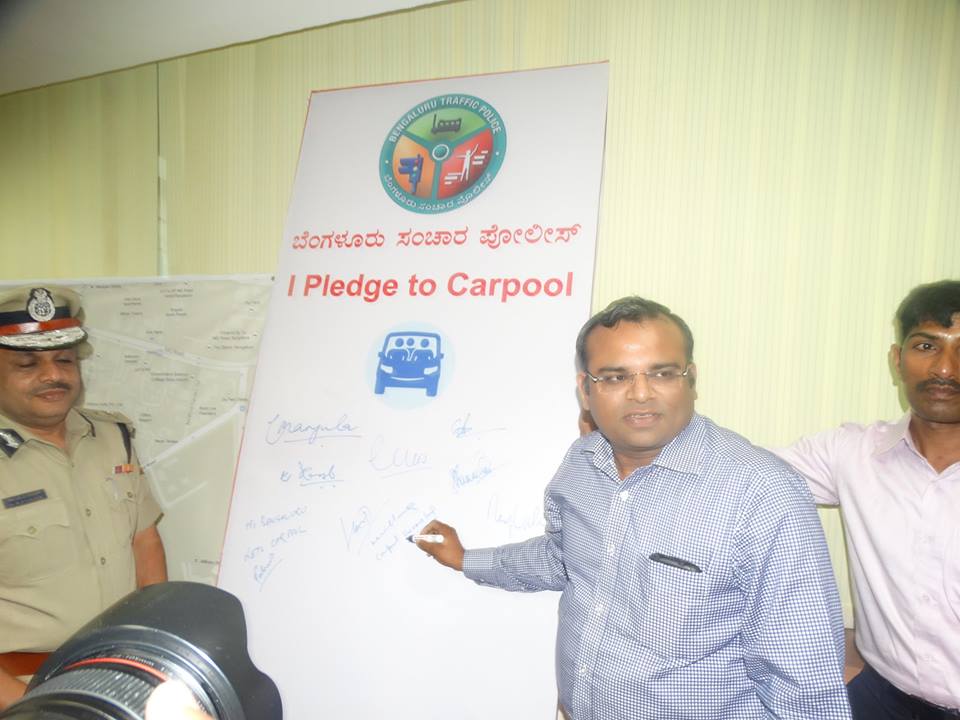
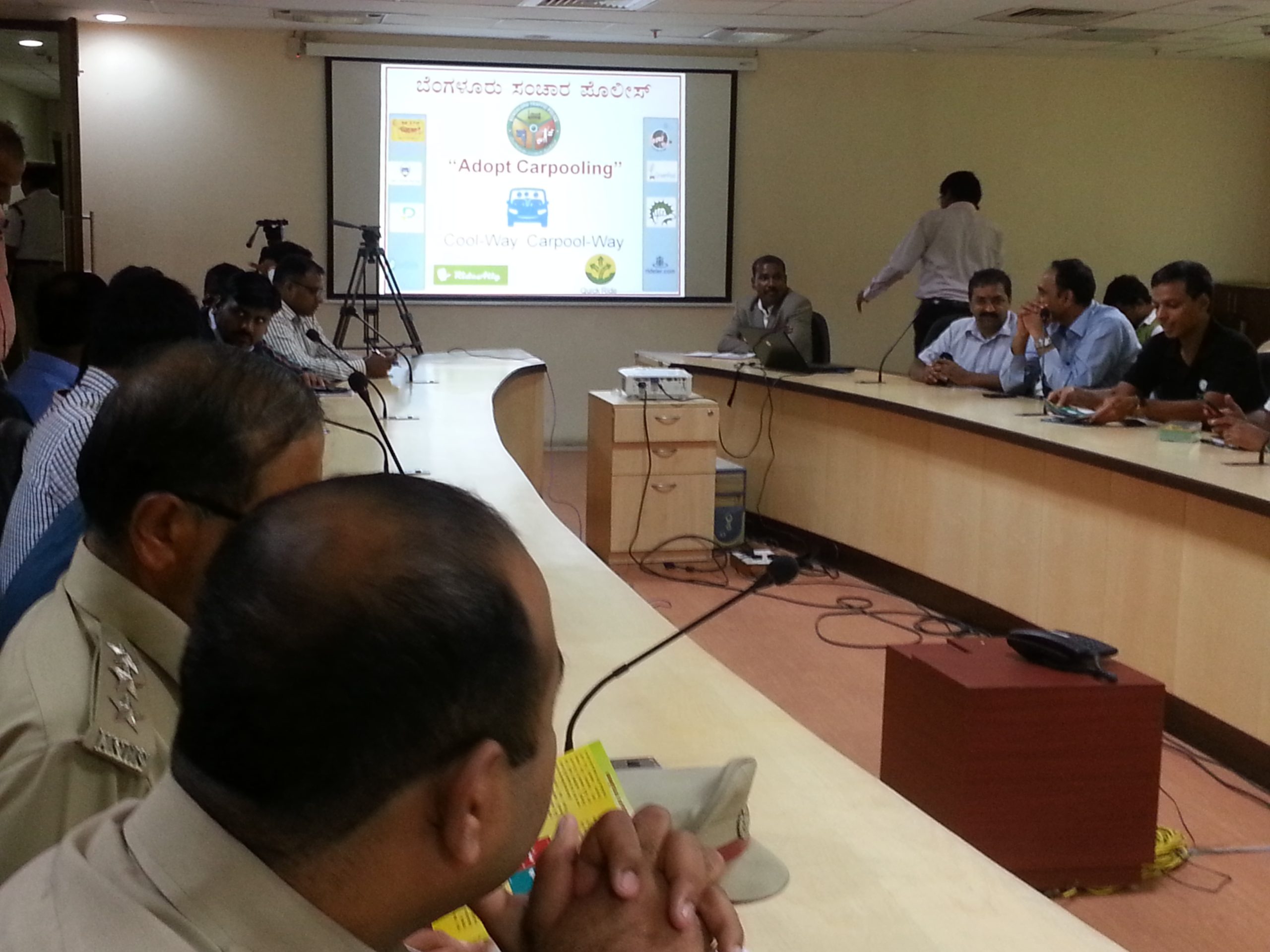
On October 21, 2015, Bengaluru Traffic Police formally launched a carpooling campaign. Eight startups working on carpooling, including RideAlly, were invited. Industry associations representing Electronic City, Outer Ring Road, Whitefield and other technology corridors participated. The campaign was launched in the presence of senior officials including then Additional Commissioner of Police (Traffic) Dr. M.A. Saleem and Principal Secretary, IT-BT, V. Manjula.
RideAlly had already been working on ridesharing since 2013.
For us, it felt as if an idea whose time had finally come was getting institutional support.
The problem in 2015 was exactly the problem we have in 2026
Drive through ORR, Whitefield, Electronic City or Manyata during office hours and look inside the cars.
Most have one person. One feels like, “Bengaluru Ki Sadkon Par Jagah Kam Hai. Gaadiyon Mein Nahi.”
A five-seater vehicle occupies almost the same road space whether it carries one person or four. Bengaluru keeps adding flyovers and Metro lines, but if every new commuter eventually occupies another vehicle, infrastructure will always be chasing demand.
That was the logic behind the 2015 campaign.
At that time, Bengaluru Traffic Police was targeting major technology corridors. The campaign hoped to remove tens of thousands of cars from the roads. By December 2015, police said around 31,500 employees across Electronic City, ITPL and Manyata Tech Park had started carpooling.
RideAlly too saw a significant increase in people sharing cars, bikes and taxis after BTP’s support. Our platform had workplace-based matching, recurring rides, verified mobile numbers and emails, vehicle-number capture, private groups, female-only pools, government-ID verification and 24/7 customer support.
The technology was not really the difficult part. The law was.
The white-board (private vehicle) problem
Suppose I drive every day from HSR Layout to Whitefield. You live nearby and work near my office. I am going there anyway.
If you travel with me, Bengaluru has potentially removed one vehicle from the road. Nobody would normally object if you are my friend or colleague.
But what happens if you contribute ₹80 towards petrol? Suddenly a very simple question becomes surprisingly complicated:
Am I still a private vehicle owner sharing my journey or have I become a taxi?
India’s Motor Vehicles Act was written long before app-based mobility became normal. Private white-board vehicles cannot ordinarily be operated “for hire or reward” without the permits applicable to transport vehicles.
But the law never developed an equally clear category for genuine, non-profit carpooling.
That distinction matters enormously.
A taxi starts a journey because a passenger has hired it. A genuine carpool driver is already making the journey and allows others travelling in the same direction to occupy otherwise empty seats.
Commercial transportation and carpooling are not the same activity. Yet India’s regulatory framework has repeatedly struggled to separate the two. Legal experts continue to describe app-based cost-sharing as a grey zone even in 2026.
Why RideAlly moved away from paid carpooling
This is also where RideAlly’s own thinking evolved.
Our early 2015 product material talked about owners saving costs through ridesharing. But as we engaged with corporates, lawyers, government departments and transport authorities, we realised there was no sufficiently clear legal basis for allowing monetary rewards on private vehicles.
Rather than build a business on an interpretation that could put our users at regulatory risk, we changed course and did not provide cost sharing option in our app.
In April 2016, RideAlly introduced its Workplace model: employees could share personal vehicles among verified colleagues, without sharing cost and not making the private vehicle a commercial taxi. Company pays RideAlly on SAAS model and promotes ridesharing (carpool, bikepool) among its staff. Staff verified company email-id and can see/travel with only colleagues. It was very successful with companies and tech parks where 1000+ people worked.
We subsequently studied the Motor Vehicles Act, participated in shared-mobility industry discussions, worked with corporate legal departments and met Bengaluru’s Transport Commissioner and Additional Transport Commissioner in 2018. RideAlly’s published conclusion in 2019 was straightforward: carpooling itself was desirable, but until regulation became clear, the platform would not enable cost-sharing or rewards on private vehicles.
And therein lies the practical problem. Carpooling without any cost-sharing depends almost entirely on goodwill. Goodwill is wonderful. It is rarely a scalable mobility model.
The car owner bears fuel, maintenance, depreciation and the inconvenience of coordinating timings. The co-passenger gets an inexpensive or free ride. Without a legitimate mechanism to share reasonable trip expenses, participation becomes difficult to sustain at City/India scale.
Over time, RideAlly concentrated increasingly on commercial cab services, where permits, insurance, driver verification, taxation, operational liability and service-level responsibilities can be clearly defined.
Now, Bengaluru is discussing carpooling again
Eleven years later, Bengaluru Traffic Police is again looking seriously at the idea.
A July 26, 2026 report in The Hindu says BTP has proposed regulated carpooling as one measure for tackling congestion. An internal BTP assessment based on data from private aggregators reportedly found that nearly 60,000 people were benefiting from carpooling before 2021, compared with around 25,000 now. Read The Hindu report
That decline should make policymakers think. Bengaluru did not suddenly stop needing carpooling. Regulatory uncertainty helped make participation harder.
In 2023, Karnataka again witnessed controversy when transport authorities objected to app-facilitated carpooling using white-board vehicles. The government’s position was that private cars should not become commercial taxis, while industry participants argued that genuine expense-sharing was fundamentally different from running a cab. Karnataka subsequently considered a policy but put it on hold while awaiting a broader central framework.
We are therefore back almost at the same question, we faced a decade ago.
What Government needs to do differently this time
Bengaluru does not need another campaign asking citizens to “please carpool”.
It needs rules that make carpooling legal, safe, auditable and worth participating in.
The first requirement is a statutory definition of bona fide carpooling. A private vehicle owner who is already travelling from A to B and shares vacant seats should not automatically be treated as a taxi simply because fellow travellers contribute towards actual journey expenses.
At the same time, regulation must prevent carpooling from becoming taxi operations through the back door.
A workable framework could have some simple guardrails:
- White-board vehicles should be explicitly permitted for genuine, non-profit carpooling, with cost recovery capped according to a prescribed formula covering fuel, tolls and reasonable vehicle expenses.
- A car owner should be allowed only a limited number of pool journeys, for example, home-to-work and work-to-home—rather than unlimited passenger trips throughout the day.
- The owner’s original journey and destination should exist independently of the passenger request. A carpooler should not roam around accepting rides like a taxi.
- Platforms should verify identity, driving licence, vehicle RC, insurance and contact details, and maintain an auditable digital trip record.
- Government and insurers should create specific carpool insurance protection, so owners and passengers know exactly what happens in the event of an accident.
- Cash payments and arbitrary pricing should be avoided. Expense contribution should be calculated transparently by the platform.
- Corporates and tech parks should be encouraged to build verified employee pools. RideAlly learned very early that travelling among colleagues or trusted communities addresses one of carpooling’s biggest barriers, safety and trust.
- Government could add positive incentives: priority parking for pooled vehicles, dedicated pickup areas at tech parks, integration with Metro stations, or eventually high-occupancy-vehicle benefits on selected corridors.
- Most importantly, Transport Department, Traffic Police, aggregators, taxi representatives, corporates, insurers and commuters must agree on one interpretation. Citizens should not be encouraged to carpool by one arm of government and fear enforcement from another.
The purpose should not be to damage the taxi industry. At RideAlly, we understand the pain and survival of drivers/vendors. We are in same boat.
Professional taxis are necessary. They serve airport passengers, people without cars, point-to-point travel, emergencies, rentals and millions of journeys where the driver is providing transportation as a profession.
Carpooling solves a different problem: empty seats inside vehicles that are travelling anyway.
So, it is encouraging to see the conversation return in 2026. But this time, we should finish what was left unfinished.
Let’s not merely promote carpooling. Define it. Legalise genuine cost-sharing. Regulate it. Insure it. Make it safe. And then let Bengaluru’s citizens do the rest.
We already understand that “I’m Not in the Traffic. I’m the Traffic”. Citizens just need a legal framework to operate.
Leave a Reply