
HAMPI- A HEAVEN ON EARTH
The abode of bygone ruins, Rusty colors and fascinating landscape.
Hampi, the city of ruins, is a UNESCO World Heritage Site. Situated in the shadowed depth of hills and valleys in the state of Karnataka, this place is a historical delight for travellers. Surrounded by 500 ancient monuments, beautiful temples, bustling street markets, bastions, treasury building and captivating remains of Vijayanagar Empire, Hampi is a backpacker's delight. Hampi is an open museum with 100+ locations to explore and a favourite way to see the city from the perspective of its history.


Hampi was the capital of the Vijayanagar empire around 1500 AD, and by some accounts, the second largest city in the world at that time. Over the next centuries it fell out of importance, and now you can explore the ruins of a lot of temples and other structures spread out over a vast area. The terrain around Hampi is as mysterious as the ruins itself – the city is surrounded by boulders of different sizes, and you can climb to the top of them with a little effort to get a stunning view of the entire city and the geography. It is located on the banks of the Tungabhadra River. Famous for its massive, beautifully carved temples, especially the Virupaksha Temple, dedicated to the patron deity of the empire. You can also find remains of the old aqueducts, canals and military barracks and stables here.
Hampi’s spectacular setting is dominated by river Tungabhadra, craggy hill ranges and open plains, with widespread physical remains. The sophistication of the varied urban, royal and sacred systems is evident from the more than 1600 surviving remains that include forts, riverside features, royal and sacred complexes, temples, shrines, pillared halls, Mandapas, memorial structures, gateways, defence check posts, stables, water structures, etc.
Among these, the Krishna temple complex, Narasimha, Ganesa, Hemakuta group of temples, Achyutaraya temple complex, Vitthala temple complex, Pattabhirama temple complex, Lotus Mahal complex, can be highlighted. Suburban townships (puras) surrounded the large Dravidian temple complexes containing subsidiary shrines, bazaars, residential areas and tanks applying the unique hydraulic technologies and skilfully and harmoniously integrating the town and defence architecture with surrounding landscape. The remains unearthed in the site delineate both the extent of the economic prosperity and political status that once existed indicating a highly developed society.
The austere, grandiose site of Hampi was the last capital of the last great Hindu Kingdom of Vijayanagar. Its fabulously rich princes built Dravidian temples and palaces which won the admiration of travellers between the 14th and 16th centuries. Conquered by the Deccan Muslim confederacy in 1565, the city was pillaged over a period of six months before being abandoned.
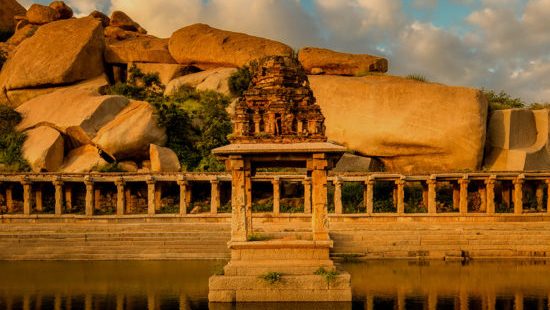
The Vitthla temple is the most exquisitely ornate structure on the site and represents the culmination of Vijayanagara temple architecture. It is a fully developed temple with associated buildings like Kalyana Mandapa and Utsava Mandapa within a cloistered enclosure pierced with three entrance Gopurams. In addition to the typical spaces present in contemporary temples, it boasts of a Garuda shrine fashioned as a granite ratha and a grand bazaar street. This complex also has a large Pushkarani (stepped tank) with a Vasantotsava mandapa (ceremonial pavilion at the centre), wells and a network of water channels.
Another unique feature of temples at Hampi is the wide Chariot streets flanked by the rows of Pillared Mandapas, introduced when chariot festivals became an integral part of the rituals. The stone chariot in front of the temple is also testimony to its religious ritual. Most of the structures at Hampi are constructed from local granite, burnt bricks and lime mortar. The stone masonry and lantern roofed post and lintel system were the most favoured construction technique. The massive fortification walls have irregular cut size stones with paper joints by filling the core with rubble masonry without any binding material. The gopuras over the entrances and the sanctum proper have been constructed with stone and brick. The roofs have been laid with the heavy thick granite slabs covered with a water proof course of brick jelly and lime mortar.
The Battle of Talikota (1565 CE) led to a massive destruction of its physical fabric.
Dravidian architecture survives in the rest of Southern India spread through the patronage of the Vijayanagara rulers. The Raya Gopura, introduced first in the temples attributed to Raja Krishna Deva Raya, is a landmark all over South India.


Leave a Reply