

SUVARNA KARNATAKA

ನಾಗಿಯುಮೇನೊ ತೀರ್ದಪುದೇ ತೀರದೊಡಂ ಮರಿದುಂಬಿಯಾಗಿ ಮೇಣ್
ಕೋಗಿಲೆಯಾಗಿ ಪುಟ್ಟುವುದು ನಂದನದೊಳ್ ಬನವಾಸಿ ದೇಶದೊಳ್
India is the land of proud history and the ancient temples, which are still standing strong depicting their endurance and beauty, are certainly testaments to it. Each and every state of India boasts of old buildings in the form of forts, palaces and temples. Karnataka is definitely one amongst these states which have prospered through battles and wars, development and sophistication.

Karnataka has been ruled by various dynasties like Maurya, Hoysala, Vijayanagara, and Chalukya, the list is endless and all these empires have left behind a rich heritage and history. The legacy in the form of temples, monuments, palaces, and forts with awestruck architecture tells thousands of stories.
The ageless monuments of Karnataka, with their unique architectural styles are a delight to the history and archaeology aficionados. The iconic stone chariot to the intricate sculptures of Halebidu or the cave temples of Badami. All of these temples are built with stone, which is one of the main feature of ancient Indian temples. The architectural designs have found a distinguished place in forming a true atmosphere of devotion for spiritual attainment.

Karnataka is known for preserving the ancient heritage since ages. This region is blessed with several beautiful temples especially belonging to the Hoysala period. These sacred landmarks not only rejuvenate the spirit but also treat the eyes with mind-boggling architecture. There are countless temples that are scattered in the region and it is indeed difficult to choose the best amongst them.
Virupaksha Temple, Hampi

Virupaksha Temple at Hampi is part of the Group of Monuments at Hampi, sits on the banks of the Tungabhadra River. The temple is dedicated to Lord Shiva and attracts huge crowds during the annual chariot festival and festivities of Virupaksha and Pampa. Virupaksha Temple at Hampi is a must visited temple while on guided tours of the state along with Hoysaleswara. One of the most ancient temples in Karnataka is that of the Vitthala temple situated in Hampi. Dedicated to Lord Vishnu, it is a popular temple set amidst the ruins of Hampi. The Vitthala temple is popular for its musical monolithic pillars and the stone chariot, an important part of the ruins, as it is one of the best UNESCO World Heritage Sites in India.
Hoysaleswara Temple, Halebidu


Halebidu is located in Hassan district in Karnataka. Ketumalla, the chief of staff of Hoysala Kingdom, built this temple during 1121 A.D and attributed to his king, Vishnuvardhana and queen, Shantala Devi. Even then it is learnt that it took 105 years to complete. If one stands on the platform of the temple and sees around he will see the hills opposite and two big bulls facing the temple and Ganesha figure on the south. Hoysaleswara Temple of Halebidu is most well known for its sculptures and dancing images.
It is believed that Queen Shantala Devi, was an epitome of beauty and fashion, she was also a great Bharatnatyam dancer and musician. Sculptors were inspired by this and the Shilabalikas, the dancing figures, are models of Queen Shantala Devi and her courtisans. History of Hoysalas mentions Shantala Devi had great influence in the adminstration and religious reforms during Vishnuvardhana reign.
In the 14th century, this glorious city fell into ruins with the invasion of Malik Kafur, Mughuls, from the North India. This place was ran-sacked and plundered repeatedly rendering it in ruins. Hence its name Halebidu, meaning ” City in Ruins”.
Monolithic soapstone or Chloritic Schist was used for the construction of these temples. The God on the northern side temple is called as Shanthaleshwara and that on southern side is called as Hoysaleshwara. The walls of the temple are covered with an endless depictions from Hindu mythology, animals, birds and Shilabalikas. Yet no two postures of the sculptures are similar.

Built after Shantala Devi, queen of king Vishnuvardhana. The Shantaleswara temple on the northern side stands on a platform like a casket in shining black soft stone – chlorite schist covered with variety of gods and goddesses, animals, birds and dancing girls. The temple took 190 years to build requiring skills of more than 20,000 laborers.
It has a Museum on the lawns that showcases 12th century sculptures and gold coins in use at the time. One km from Halebid is Basti hill with Jain bastis with gleaming black stone pillars.The Parshwanatha Swamy temple is the most important and well preserved one. The idol is 14 feet tall and is carved out of blackstone and bears a 7 headed serpent on its head.
Chennakeshava Temple, Belur
Chennakeshava Temple at Belur is the most favored tourist destinations in Karnataka state and one of the heritage temple in India. The marvelous temple built on the banks of the Yagachi river and have been proposed for world heritage sites.

The old temples of Karnataka’s Hassan district are an architectural wonder. And the town of Belur is home to one of the grandest examples of Hoysala architecture, the Chennakesava Temple. The temple was built in the early 12th century by the Hoysala ruler, Vishnuvardhana, when the town of Belur was the site for the capital of the Hoysala kingdom.
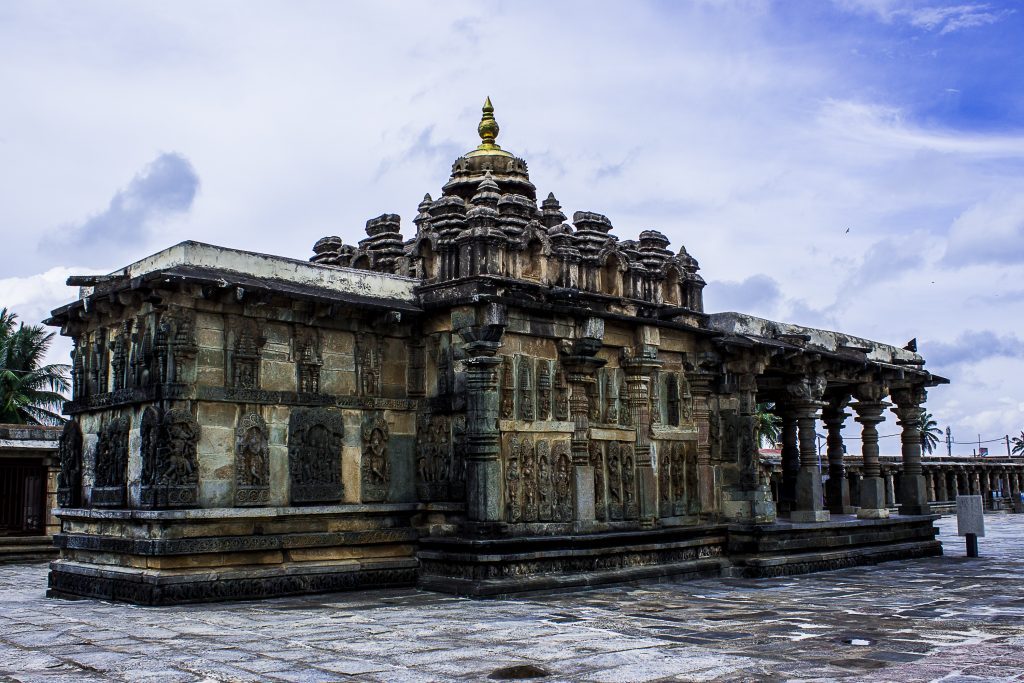
The Hoysalas ruled the region for more than three centuries and to this day people from all over the region flock to the Chennakesava Temple, Belur to admire the intricate works of art and sculpture and feel the old-world spiritual charm of the site.


The Hoysalas used soft soapstone for their structures as they were found suitable for intricate carvings. Enclosed by a Prakara with a Gopura built in the Vijayanagar style, the temple stands on a platform or Jagati and looks like a huge casket. The fine workmanship and skill visible in this masterpiece is truly breathtaking.


The Chennakesava temple is a fine example of fine quality work of art in stone. There are more than 80 Madanika sculptures in the temple, dancing, hunting, standing under canopies of trees and so on. The 4 Madanika figures (striking elegant dancing poses) on the wonderfully engraved columns of Navaranga are unique creations of Hoysala workmanship. The Garbhagriha is stellar in shape and its zigzag walls make the figures of 24 forms of Vishnu look different at different times of the day due to light. The temple was built by master craftsmen – Dasoja and Chavana, a father and son duo, hailing from Balliganve, a centre of Kalyana Chalukya art in Shimoga district. It is said that Shantaladevi, the accomplished queen of King Vishnuvardhana is the model for one of the sculptures in the Vavaranga – Darpana Sundari. This work of art alone, speaks for the beauty of the magnificient temple. The temples of Kappe Chennigaraya, Soumyanayaki, Andal and other Vaishnava manifestations surround this main temple. Belur also has a samadhi believed to be of Raghavanka, the celebrated Kannada poet of the 13th century.
Vidyashankara Temple, Sringeri
Vidyashankara Temple at Sringeri is dedicated to Lord Shiva, known for magnificent architecture and beautifully built entirely out of carved stone. Sringeri Sharada Peetham is located on the banks of the Tunga river in Chikkamagalur district.

The Vidyashankara Temple was built in the year 1338 A.D. It is a unique monument built entirely of stone combining both Hoysala (Chalukya) and Dravidian architectural styles. The structure stands on a high plinth and commands a magnificent view from the hills and their slopes all round. It is more or less a rectangle with apsidal east-west ends. On the western side is the Garbhagriha, with Vidya Ganapati on one side and Durga on the other side of the entrance. On the other three sides of the Garbhagriha are shrines to Brahma, Vishnu and Maheshwara with their consorts. In the eastern half of the structure is a mandapa with twelve pillars, huge monoliths carrying large figures and carrying heavy projecting corbels on top. These twelve pillars are marked by the twelve signs of the zodiac in their regular order. The central ceiling is an exquisite piece of workmanship with lotus and pecking parrots.
The Vidyashankara temple in Sringeri near the Sharada Peetham is one of the highlights of this place. Sringeri is the site of one of the original Advaitha mathas established by Adi Shankara himself. It has a continuing tradition and recorded history from the eighth century. Sri Adi Shankara’s disciple Sureshwaracharya was the first head of this matha.
The Sringeri Matha’s continued lineage is traceable through various records. Two of the most famous pontiffs of this matha are Vidya Shankara or Vidyathirtha and his disciple Vidyaranya.
Vidyaranya is a legendary figure in the history of Karnataka, and also South India. His period saw the beginning of Muslim incursions into the south. Vidyaranya was instrumental in helping the brothers Harihara and Bukka establish the Vijayanagara Empire, which served as a fortress for defending Hindu traditions and temples against the tidal wave of Muslim invaders from the North.
Vidyaranya it is believed influenced the brothers Harihara and Bukka to have a temple constructed over the Samadhi of his Guru, Vidyathirtha. This temple is known as Vidyashankara Temple. Built around the Samadhi of Vidyathirtha, this is a beautiful and interesting temple which bears a slight resemblance to an old Chariot. It combines the general features of Dravidian style with the Vijayanagara style. Standing on a richly sculpted plinth, this temple has six doorways. Twelve pillars surrounding the mandapa with figures of the twelve signs of the zodiac. They are constructed in such an ingenious way that the rays of the sun fall on each pillar in the chronological order of the twelve months of the Hindu calendar. Each column is topped by a Yali with a rolling stone ball in its mouth.
Inside the temple, on the floor, a circle is drawn with lines corresponding to the shadows cast by each pillar. There are five shrines here. The main shrine has a Shiva Linga over the Samadhi of Sri Vidyashankara and it is known as Vidya Shankara Linga. The other shrines are for Brahma, Vishnu, Shiva and Durga. The Garbhagraha is topped by a majestic square vimana.
This temple also houses a broken sandalwood idol of Sharadamba, believed to have been installed in the Sharadamba temple by Adi Shankara Himself. This idol, it is believed, was damaged during the Muslim invasion, and Sri Vidyaranya had the current Gold statue of Sharadamba installed in its place.
Leave a Reply